AXIO360 PLATFORM
 SERVICES
 SOLUTIONS BY ROLE

 ABOUT
ABOUT
 PARTNERS
 RESOURCES
Hundreds of thousands of companies are standing up AI governance programs right now, racing to keep pace with regulators in the EU, APAC and beyond. Most are building governance the hard way: bolting AI oversight onto existing cybersecurity and data-governance programs, treating emerging AI regulations as a compliance floor, or outsourcing judgment to outside counsel or consultants and accepting the work product at face value.
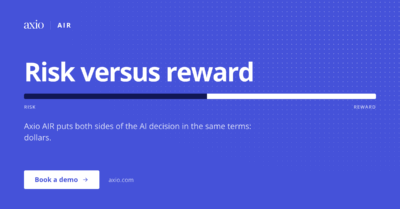
None of these approaches answer the one question that actually matters to executives and Boards: is this particular use of AI worth the risk? That’s right – the age old business balance: risk versus reward.
Governance Without Numbers Is Just a Checklist
The motivation is well intended and justified. Every AI governance framework promises to help you manage risk. Few of them tell you, in monetary amounts, what “risk” actually means for a given use case. Without that number, “governance” collapses into a checklist exercise — a set of policies and approval gates that can’t actually distinguish a low-stakes marketing experiment from a decision that could take down critical infrastructure.
That distinction is essential because when — not if — an AI initiative goes wrong, the Board and the C-suite will be the ones standing in front of regulators, auditors, customers and shareholders alike, each of whom are actively looking for evidence of negligence. A policy binder and a checklist will not protect them. What protects them is a documented, dollar-quantified rationale showing that leadership understood the financial exposure of each AI use case and made a deliberate, informed call. That is the cornerstone of fiduciary responsibility — and it is the defense that holds up in a legal challenge or a regulatory inquiry.
A Better Approach: Quantify the Downside Before You Approve the Use Case
The great news is that a better approach exists – one that is simple to implement and understand, cost effective, and quick. Platforms like Axio change the equation. Simplifying digital risk quantification — historically a slow, specialist-driven discipline — puts governance-ready financial insight into executives’ hands in minutes, not months. The result is a governance process built on business impact, not intuition:
- Marketing wants AI to generate and target digital ads. Worst case: the campaign misses its audience. Estimated loss: $500K in wasted spend. Verdict: acceptable — the downside is a routine cost of doing business.
- Engineering wants AI to auto-patch vulnerabilities in an e-commerce platform. Worst case: a missed vulnerability is exploited, exposing the customer loyalty database. Estimated loss: $5M in forensics and remediation. Verdict: acceptable only with with guardrails — proceed only if efficiency gains clearly outweigh the exposure.
- Production wants to leverage AI to manage industrial control systems for remote gas transport infrastructure. Worst case: a misread environmental signal triggers an over-pressurization event, explosion, infrastructure destruction and human life impact. Estimated loss: $1B. Verdict: not acceptable — no efficiency gain justifies this level of exposure.
Empowered by Axio, every decision has a financial threshold enable better, empirically supported business decisions.
Why This Approach Wins
- It’s board-defensible, not just documented. Evidentiarily supported monetarily informed risk assessments deliver directors and executives a contemporaneous, record that a specific financial exposure was known, weighed, and consciously accepted or rejected — the exact standard regulators, auditors, and plaintiffs’ attorneys test for when they ask whether leadership exercised due care.
- It withstands scrutiny after the fact. When an incident happens, the question is never “did you have a policy?” — it’s “what did you know, and when?” Axio’s quantified output gives the Board a paper trail that answers that question before a challenger ever asks it.
- It’s fast. Risk insight in minutes means governance can move at the same speed of your organization’s AI adoption — not months behind it, and not scrambling to reconstruct a rationale after the fact.
- It’s simple. No new framework to learn — quantified risk slots directly into the approve/guardrail/deny decisions organizations already make.
- It scales across the business. The same method that clears a marketing use case in seconds is rigorous enough to stop a billion-dollar infrastructure risk before it happens.
Effective AI governance isn’t about having the thickest policy binder — it’s about giving your Board an unassailable, numbers-backed position before you ever say yes. That’s the capability Axio delivers.
Schedule a demo at axio.com/demo-now to see it in action.