AXIO360 PLATFORM
 SERVICES
 SOLUTIONS BY ROLE

 ABOUT
ABOUT
 PARTNERS
 RESOURCES

Say Yes to AI: Why We Built Axio AIR
Over the past year, I’ve had some version of the same conversation with dozens of CISOs. It usually starts the same way: “I don’t want to be the one who says no to AI.” And it usually ends the same way too: “But I honestly don’t know what can happen if I say yes — or what it’s actually going to cost me if it does.”
That gap, between not wanting to be an obstacle and not having enough information to do otherwise, is where Axio AIR was born.
The pressure CISOs are actually under
Nobody wants to be known as the department of “No.” AI is moving too fast, and the business case for adopting it is too obvious for security and risk leaders to plant their flag in “Wait.” Roughly 90% of enterprises have already deployed AI in some form. The pressure to keep moving is real, and it’s coming from every direction at once: the board wants innovation, the business wants speed, and regulators are quietly building the scaffolding — the EU AI Act’s high-risk obligations chief among them — that will eventually hold someone accountable for what gets deployed and how.
What almost none of those CISOs had was a way to answer the question underneath it all: what is our actual exposure, in terms the board, the regulators, and the business can act on? Not a maturity score. Not a red-yellow-green heat map. They needed a number. A defensible one.
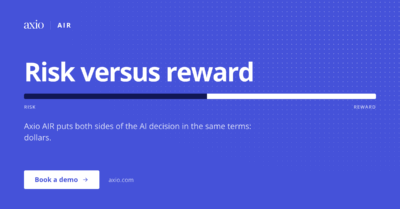
That’s the same problem Axio has spent over a decade solving for cyber risk. We built our name on the belief that risk isn’t real to an organization until it’s expressed in dollars. A board can’t prioritize what it can’t compare, and a CISO can’t get budget for what they can’t quantify. Listening to those conversations, it became clear we weren’t looking at a new problem. We were looking at the same problem, showing up in a new place.
Why we built it the way we did
We didn’t want to hand CISOs another framework to interpret, or another dashboard to babysit. We wanted to give them something they could actually use in the room — with the board, with underwriters, with their own teams — in minutes, not months. So, we built Axio AIR around four things that, in every one of those conversations, kept surfacing as what was actually missing:
Implement fast. Traditional AI risk assessments mean weeks of workshops and consulting engagements before anyone sees results. That timeline doesn’t match how fast AI is actually getting deployed inside these organizations. Axio AIR extends the same Axio360 quantification methodology that our clients already trust — it’s not a new tool to learn; it’s the tool they know, pointed at a new class of risk.
Uncover risk fast. Axio AIR models AI and agentic risk at the model, system, and portfolio levels, using a purpose-built scenario library and AI-specific loss exceedance curves. A prompt injection scenario against a customer-facing LLM, for example, might come back as $4.2 million in modeled annual loss exposure, with a 95th-percentile exposure of $11.8 million. That’s not a score. That’s a number a CFO can put in a spreadsheet.
Suggest remediation automatically. Knowing your exposure is only useful if it tells you what to do next. Axio AIR generates prioritized remediation activities for every scenario, mapped to the frameworks these teams are already measured against, such as NIST’s AI Risk Management Framework, MITRE ATLAS, the CSA RiskRubric, and COSO’s GenAI control principles.
Be ready before something happens. Quantifying the risk isn’t the finish line. We built in incident readiness from the start, including 2/10/15-day reporting readiness aligned to the EU AI Act’s Article 73, AI-specific tabletop exercises, incident runbooks, and regulator-ready timeline reconstruction. This way, when an AI-related incident does occur, the organization already has the artifacts it needs, instead of assembling them under pressure.
Speed without giving up fidelity
The hardest part of building this wasn’t the speed. Speed is table stakes at this point; if it takes weeks, it’s already too slow for how fast AI is being deployed. The hard part was making sure that speed didn’t cost us the thing Axio has always been trusted for: fidelity. High-fidelity, transparent, financially defensible numbers — not a shortcut version of risk quantification, but the real thing, delivered faster.
That’s the tension we designed around. Every number Axio AIR produces has to hold up in front of a board, an auditor, or an insurance underwriter, the same way our cyber risk numbers always have. We didn’t build a faster version of a worse answer. We applied the same rigor we’ve always stood for, applied to a risk category that didn’t have it yet.
What this means for the CISOs I’ve been talking to
None of this is about telling security leaders whether to say yes or no to AI. It’s about making sure that when they do say yes — and most of them will — they’re saying it with their eyes open. With a number attached to the exposure. With a plan for what to fix first. And with the readiness to respond well if something does go wrong.
That’s the answer I wanted to be able to give to the CISOs who’ve been asking me this question all year. Now we can.
If you want to see what your organization’s AI exposure actually looks like in dollars, you can book time with our team at axio.com/demo-now.